
The Google API leak and Department of Justice antitrust case revealed something many of us suspected but couldn’t prove: Google ignores a massive number of links.
Not because they’re “unnatural” or bought. They get filtered out because they fail basic relevance checks that most SEOs never think about.
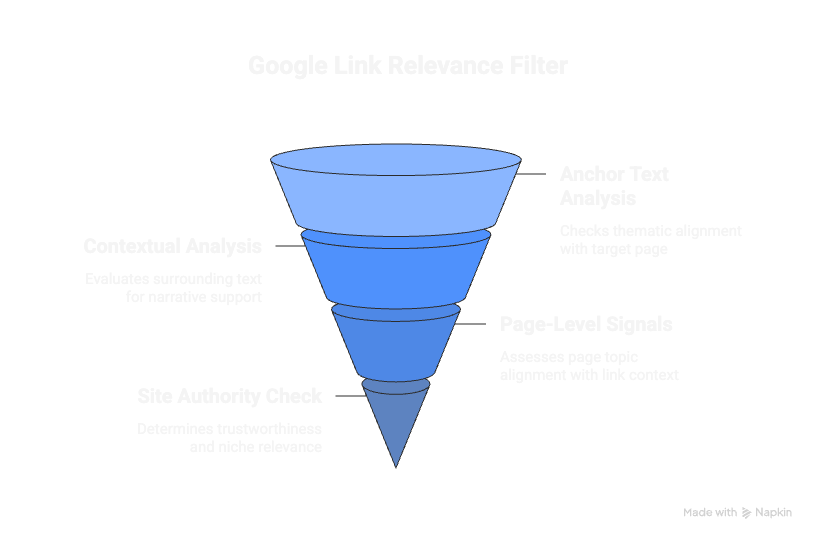
Here’s what we now know Google examines when it encounters a link.
The anchor text matters, but not how you think
Google reads the clickable text and compares it to the page being linked to. If there’s too much distance between what the anchor says and what the target page is about, the link gets demoted or ignored entirely.
This isn’t about exact match anchors. Google looks for thematic alignment. An anchor that says “quarterly financial analysis” pointing to a page about “investment strategies for retirement” might work. The same anchor pointing to “best pizza restaurants in Chicago” won’t.
Context beats individual words
Google doesn’t just read the anchor. It captures the text before and after the link to understand the full story being told.
This is what they call “surrounding text” in their documentation. If your anchor says “click here” but the sentence around it explains “this comprehensive guide to organic gardening covers everything from soil preparation to pest management,” Google uses that fuller context.
The surrounding text provides the narrative. The anchor is just part of it.
Page-level signals create the final filter
Google maintains what they describe as a “bag of keywords” for each page. This is their understanding of what the entire page discusses, separate from any individual link.
When they evaluate your link, they’re checking: Does this anchor make sense? Does the surrounding text support it? Does the page topic align with both?
If a link about “machine learning algorithms” sits on a page discussing “best breakfast recipes,” Google knows something is off. The page context contradicts the link context.
Site authority still matters
On top of all this textual analysis, Google knows whether the linking site is trustworthy and whether it operates in the right niche for this particular topic.
A link from a respected financial publication carries weight when pointing to investment content. The same site linking to plumbing services doesn’t make topical sense, regardless of how well the anchor and surrounding text are crafted.
What this means for link building
Google has built a sophisticated filtering system. They can afford to ignore links that don’t pass multiple relevance checks because they have millions of other signals to work with.
This changes how you should think about acquiring links:
Stop chasing volume. One link that passes all these checks is worth more than ten that get filtered out.
Control the narrative. When you pitch for links, provide suggested anchor text and surrounding copy that creates clear thematic alignment. Don’t leave it to chance.
Match the page topic. Getting your link added to a random blog post about unrelated topics is a waste of time. The page needs to be about something connected to your content.
Choose relevant sites. A link from a site in your niche or adjacent topics will always outperform one from an unrelated site, regardless of that site’s domain authority.
The real test
Ask yourself this about any link you’re building: If Google strips away the domain authority and just reads the anchor, surrounding text, and page content, would they understand why this link exists and what it’s trying to say?
If the answer is no, you’re probably building a link that will get ignored.
The days of “just get links from high DA sites” are over. Google has the data and the systems to filter out irrelevant links at scale. Your job is to build links that tell a coherent story across every signal they measure.
Get the alignment right, and you build links that actually move rankings.